
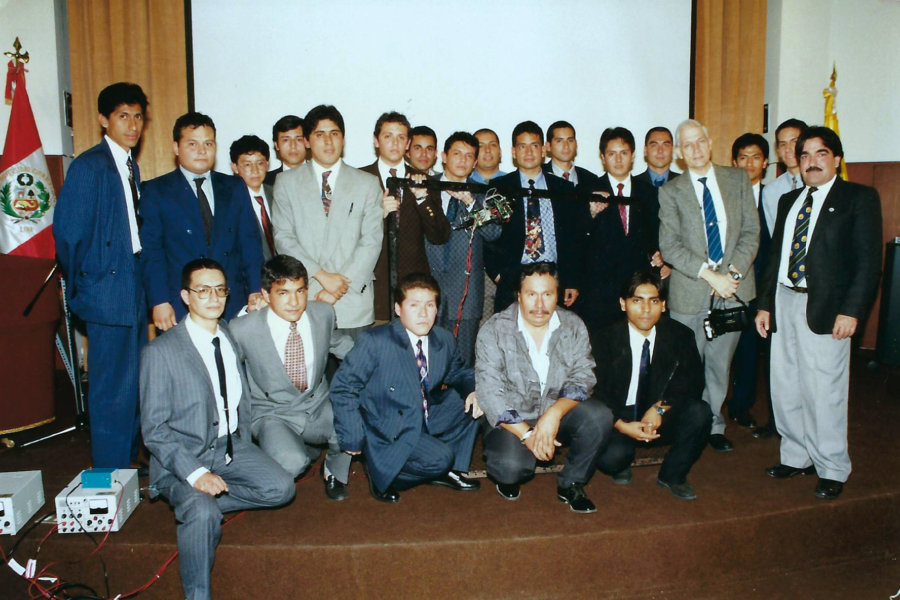
In 1987, a group of professors from the Electricity Area of the Mechanical Engineering Section accepted the challenge of contributing to the creation of the Electronic Engineering specialty. After several studies, the transformation of the Electricity Area into the Electricity and Electronics Section was approved and the Section was put in charge of managing the new career. In 1989, thanks to an important donation from the Southern Peru Cooper Corporation, a building of approximately 1000 m2 was built to house the laboratories of the specialty and the full-time professors. Currently, the Electricity and Electronics section comprises 4 work areas, whose teachers are dedicated to the training of professionals and research in: Circuits Electronic Systems, Robotics, Control and Automation, Electricity and Bioengineering.
The increase in the number of new students led to the hiring of professors, the expansion of services and the creation of laboratories. Thus, the first laboratory was the Electronics laboratory (currently the Circuits and Electronic Systems laboratory), which was built in a 120 m2 environment, where 16 work tables were installed with the capacity to attend up to 32 students per session. Continuing with the style of the former Electricity area of the Mechanical Engineering section and taking into account the limited resources at a time of severe economic crisis, the professors of the section designed the work tables and these were built within the university itself. Educational modules were purchased and assembled also within the section. The main idea was to design and build whatever was possible within the country and to work with national suppliers for any equipment that had to be imported. This was achieved, on the one hand, by developing skills in technology and, on the other hand, by saving significant amounts of money.
At the beginning, the most important aspect that was worked on in the section was the hiring of full-time professors. The group of professors coming from the Mechanical Engineering quarries was joined by an important number of young electronic engineers from the National University of Engineering, several of them being at the top of their respective promotions.