
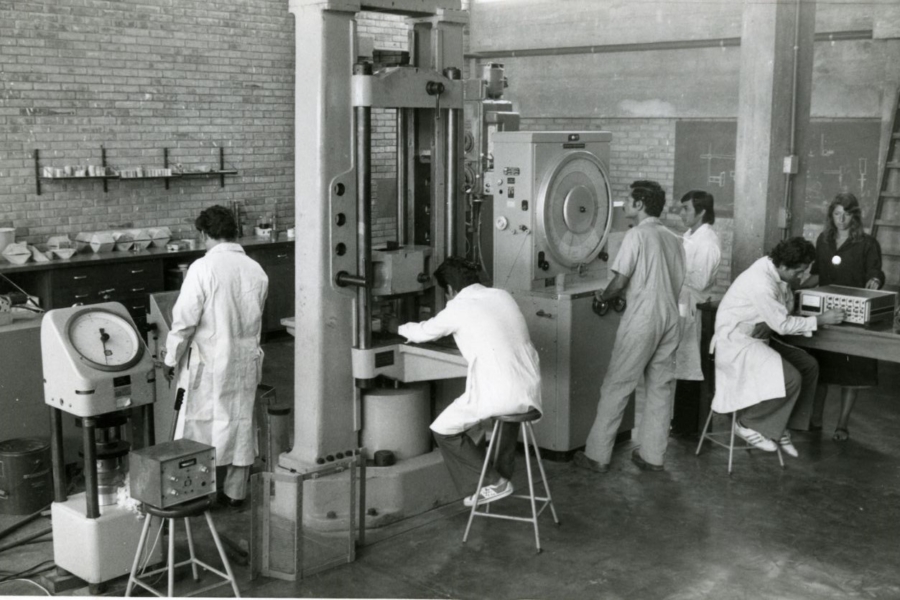
The Mining Engineering Section was created in 1970 thanks to an agreement between the British Government (University of Wales, Cardiff) and the Peruvian Government (Pontificia Universidad Católica del Perú). The rector at that time, S. J. Felipe Mc Gregor, had the invaluable support of Eng. Alberto Benavides de la Quintana and numerous mining companies interested in developing professionals in Mining Engineering.
Thanks to the technical support of the government of Great Britain, the Section obtained equipment for its laboratories and received a delegation of British professors who, together with their Peruvian colleagues, carried out academic work during the first ten years of its creation. Throughout its history, the Section has grown thanks to the support of private companies in the mining sector and its international cooperation alliances. In 1994, the company Southern Peru Copper Corporation (SPCC) sponsored the construction of the second and third floors of the Mining Engineering Pavilion.
In 1998, thanks to the signing of an agreement with the Inter-University Council of French-speaking Universities (CIUF) of Belgium, the laboratories of Mineral Concentration, Pyrometallurgy, Hydrometallurgy, Environment and Chemical Analysis of Minerals were equipped. In 2005, the company Hochschild provided equipment for the computer laboratories. In 2008, Glencore sponsored the construction of the Hydrometallurgy Laboratory. In 2009, Rio Tinto sponsored the remodeling of the geological sample preparation room and the space to install the scanning electron microscope for quantitative evaluation of minerals, which is currently known as the Qemscan Laboratory.
The Mining Engineering Section contributes to the cultural heritage of the PUCP by housing the Georg Petersen Geological Museum, which contains the valuable personal collection of Dr. Georg Petersen Gaulke, renowned researcher and professor, with more than a thousand specimens of minerals, rocks and fossils from Peru and the world. Most of these valuable pieces were collected during his travels while others were obtained through exchanges with other countries. This sample is complemented with other valuable contributions from scientists in the field of Geology, as is the case of the important donation received by Mr. Steven Botts in 2009. The collection continues to grow with donations from former students, professors and friends. At present, the museum exhibits samples of the metallic products that we export, diverse rocks found in the Peruvian Andes, fossils of fish and other marine animals that are currently found in the Peruvian Andes, and fossils of fish and other marine animals that are currently found in the Peruvian Andes.