

The results of the winners of the ProScience Contest in the Applied Research category were announced, and 8 projects from the Engineering Department were eligible. One of them is the project led by Omar Troncoso, professor of the Mechanical Engineering Section.
This project, requested by the PUCP, is supported by the Engineering Department and the Polymers and Composite Materials Group, with the National University of Juliaca (Puno) as a partner.
Thematic Area: Renewable energies
The research, led by Omar Troncoso, has the participation of co-investigators such as Fernando Torres, professor of Mechanical Engineering PUCP and Edwin Huayhua from the National University of Juliaca. The project will be developed in the district of San Miguel, Lima and in Juliaca, Puno, during a period of 36 months.
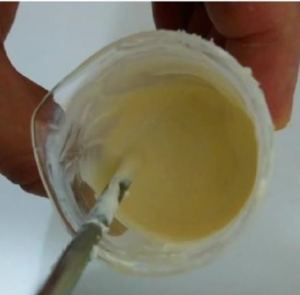
The project proposes to use rubber made from the latex of the Shiringa (Hevea brasiliensis) from the Peruvian Amazon as the main input for the development of new dielectric elastomeric generators (DEG).
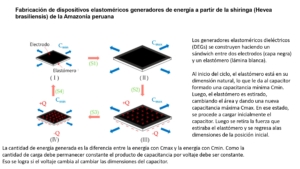
DEGs are a new type of generators that transform mechanical energy into electrical energy and could serve as a power source for lightweight, portable and flexible electronic devices, thus avoiding the use of batteries that often have a high environmental impact due to their content of hazardous chemicals and heavy metals.
To maximize the performance of DEGs, an elastomer with the highest possible dielectric constant (k) is required. In this project we propose to produce nanocomposites from Shiringa latex to maximize its dielectric constant. Two types of reinforcement will be used: i) ceramic nanoparticles (k=300) and ii) graphene. The content of these reinforcements will be optimized to maximize the resulting k of the prototype DEG to be fabricated.
This will produce a latex that will enable the development of a new nanomaterial industry for energy applications. This will benefit the Amazonian communities dedicated to shiringa harvesting, which will obtain a product that can form part of a production chain.This will benefit the Amazonian communities dedicated to shiringa harvesting, which will obtain a product that can form part of a higher-value production chain.
For several years, we have been working with the POLYCOM group on the applications of different plastics for energy storage and generation. We have found that it is possible to use biodegradable plastics such as starch, carrageenan, and other polysaccharides as raw materials for energy storage and generation.or starch, carrageenan, and other polysaccharides as raw materials for the fabrication of triboelectric surfaces.
"We have continued to look for other ways to transform mechanical energy into electrical energy. In the case of this project, natural latex will be used to manufacture a biodegradable elastomer. The deformation capacity of natural latex will be used to transform deformation energy into electrical energy," says Omar Troncoso.
The search for sustainable materials and processes for the development of new high-impact applications is one of the main motivations. This project addresses two current problems: the use of synthetic plastics and the generation of energy for the large number of electronic devices.
Troncoso adds: "We are very happy and committed to the development of new research projects and technological developments. We believe that these projects are a way for the university to generate knowledge with a focus on sustainability".
"We are currently at the stage of drawing up the Project's Operational Plan. Once it is defined, we will be able to receive funding," says our teacher.
"We would like to thank the Mechanical Engineering Section and the Engineering Department for their support at the time of application and execution of ProScience projects. We would also like to thank the VRI, which supports the initiatives and gives us support during the execution," he concludes.
Through collaboration and institutional support, we continue to advance the development of technologies that not only have a significant impact in the field of renewable energies, but also contribute to the well-being of Amazonian communities and care for the environment.
Comments