
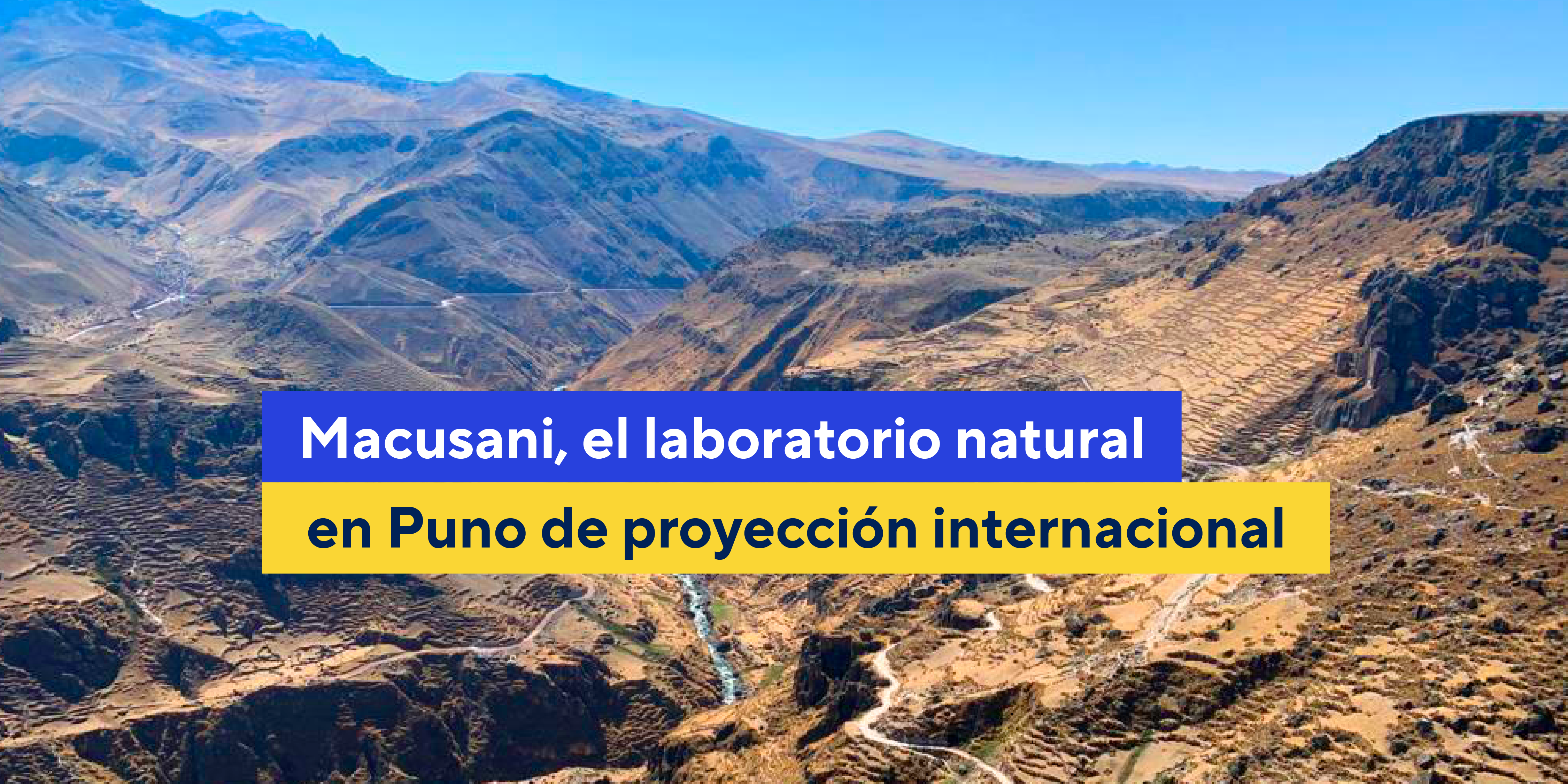
Macusani, a district located in the department of Puno with only fifteen thousand inhabitants, holds in its soils a wealth that aims to boost development in the area and the country in the coming years. Lisard Torró, professor and researcher of the Academic Department of Engineering PUCP in the career of Geological Engineering, made a finding of worldwide interest as part of a ProCiencia project on lithium mineralization in this region of the country.
A week ago, Torró published an article at www.nature.com about his most recent research conducted in this area. The delivery is the result of the work of a multidisciplinary group of experts from different universities in Europe and the United States, led from the PUCP, who contributed with their expertise in different areas of geology and materials science.
Lisard points out that conducting this research as well as publishing it was a challenge, because researching lithium deposits was stepping out of their academic comfort zone. He also mentions that Falchani is an "unconventional" lithium deposit, with unique characteristics, so they could not follow a manual or recipe to fit the pieces into this puzzle.
At the academic level, in the geosciences, this research stands out for being the first description of lithium micas (lepidolite and zinnwaldite) in rocks of volcanic origin in the world. "We are not talking about micas with some lithium, but true lithium micas in which lithium is structural," Torró says enthusiastically. At the national level, this represents the first scientific publication on Falchani, discovered in 2017 and which represents the only lithium deposit in Peru.
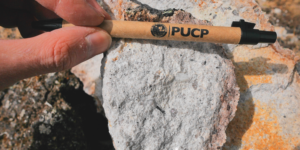
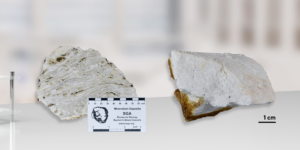
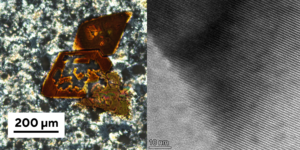
(1) Samples collected during field work at Falchani (2). Lithiferous tuff sample, the main lithium ore in the Falchani deposit.(3) Lithiferous tuff sample, with its characteristic white color, with small black minerals corresponding to the lithium micas (lepidolite and zinnwaldite).(4) Detail of zinnwaldite crystals with lepidolite rim in tuff matrix seen under the optical microscope (5). Detail of crystal alignment in very high magnification image obtained with transmission electron microscopy at the University of Granada.
Joaquín Proenza and Cristina Villanova from the University of Barcelona participated in the conceptualization of the research, as well as in the mineralogical characterization of the lithium micas. In this research they used field emission electron microscopy, RAMAN spectroscopy and electron microprobe to obtain X-ray elemental maps. These analyses were performed at the Scientific and Technological Centers of the University of Barcelona (CCiTUB).

"Having been part of this research has represented the gateway to a geological system (volcanogenic lithium deposits) new to me, and also quite unknown in the world. In this case, it has been a challenge, because it represented working with a blank canvas, since we could not compare the data with any known ore deposit model. Studying the Falchani samples is a real privilege, because of their historical (the "macusanite" glass) and geological importance, and they will surely lead to unique discoveries. It has also been a real pleasure to work with this excellent, international and multidisciplinary team, also full of young talents, who are going to go a long way."
Cristina Villanova de Benavent - University of Barcelona
"It has been a luxury to be part of the team, led by Dr. Torró (PUCP), that has carried out the research on the Falchani deposit. This mineral deposit is unique worldwide and represents a very promising alternative to the main conventional lithium deposits (Andean salt flats and the "hard rock" deposit in Australia). and "hard rock" deposits in Australia). For us, the whole process of crystallochemical process of crystallochemical characterization of lithium micas in rocks of volcanic origin and, above all, to be able to demonstrate that it was a relevant ore (mineral of economic value) of this battery metal."
Joaquín Proenza - University of Barcelona
As part of the team, Patrice Baby, a guest professor of Geological Engineering at PUCP, joined the team and made some field visits. Johan Ramirez and Mercy Sanandres, graduates of the same career at our university, also joined the research team.
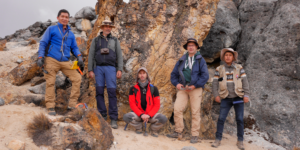
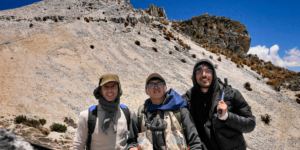
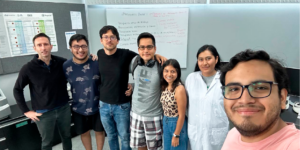
(1) Johan Ramirez and Lisard Torró during field work at Macusani - Puno in 2023 (2) Patrice Baby, Lisard Torró and Jean Vallance together with Macusani Yellowcake geologists during field work at Macusani - Puno in 2021. (3) Mercy Sanandres, Lisard Torró, Johan Ramírez and part of the PUCP Mineral Deposit Geology research team.

"Having participated in this research has been a deeply enriching experience both professionally and personally. Knowing that our work can contribute to a better understanding of the country's strategic resources fills me with pride. In addition, working as a team with committed researchers and sharing the scientific process from sample collection to analysis of results has reaffirmed my vocation for science. This project motivated me even more to continue developing myself in the field of geology and to value the potential that research has to generate useful and applicable knowledge."
Mercy Sanandres - Engineer Geologist PUCP

"In the case of Falchani my interest was focused on studying the relationship between magmatic processes and the concentration of rare metals because my line of research is metallogeny. This experience has been extraordinary because I have had access to data processing of great impact in the scientific community. It represents a great learning for me to deepen in data processing but especially the richness that I highlight is having been able to discuss its implications in metalogenetic models with experts in the field."
Johan Ramírez - Geologist Engineer PUCP
Lithium for the country's economic development
Currently, the search for critical elements in the transition to low-carbon energy is leading to research into alternatives to "conventional" deposits (e.g., in the case of lithium, salt flats), and in recent years a few papers have appeared on volcanogenic lithium deposits, about which very little is known.
Lithium deposits have a relevant role in the economic development of local communities through the creation of jobs for the population in the area of direct influence. However, its extraction has some challenges related to the sustainable management of natural resources, the environment and respect for the indigenous communities in the areas of exploitation.
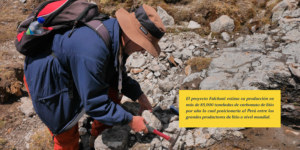
This research provides crucial information for lithium exploration in volcanic fields, and documents for the first time that micas in pyroclastic rocks constitute a relevant lithium ore. "This research is just a starting point," says Proenza.
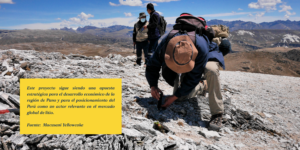
It is important to note that Peru is a leading mining country at a regional and global level. So far we are not lithium producers, but with Falchani we are in a very good position to enter the circle of lithium producing countries in the coming years. Although it is only one deposit in our country, Falchani is a large deposit, with resources of more than 1 million tons of lithium metal.
Next steps in this exploration route
Torró highlights that when he arrived at PUCP in 2018, the interest of the university arose, raised by the Vice Rector of Research and the Head of Department to develop research related to the existence of lithium in the country. He emphasizes the vision that the university had for being a pioneer in investigating the subject and how they triggered what today is the first result of this work as part of a first Prociencia Project that will have continuity in future deliveries by him and his team.
Although his area of research was focused on the study of base and precious metal sulfides, this seeded interest forced him to leave his comfort zone. After some years of field explorations, sample analysis, trips and spaces to rethink the findings, a collaborative relationship has been built with Macusani Yellowcake and today it bears fruit with thisfirst publication available to all in a journal of greater scope and prestige.
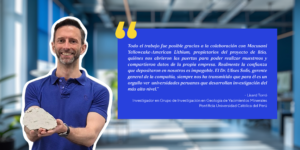
Finally Torró shares that this article might seem like the end of a cycle, but in reality it is only the first piece of the puzzle. Falchani has much more to contribute, scientifically we are just seeing the surface. His commitment is to continue to conduct research at this site under a new PROCIENCIA project entitled: "Battery metals in Peruvian deposits: sources, geological mechanisms of concentration and mineralogical expression.". Not everything is written about lithium, its applications and benefits for Peru. Each new result brings a surprise. The invitation is made, stay tuned for new chapters to be written by Lisard and his team in this story.
You can access the article here
Comments