
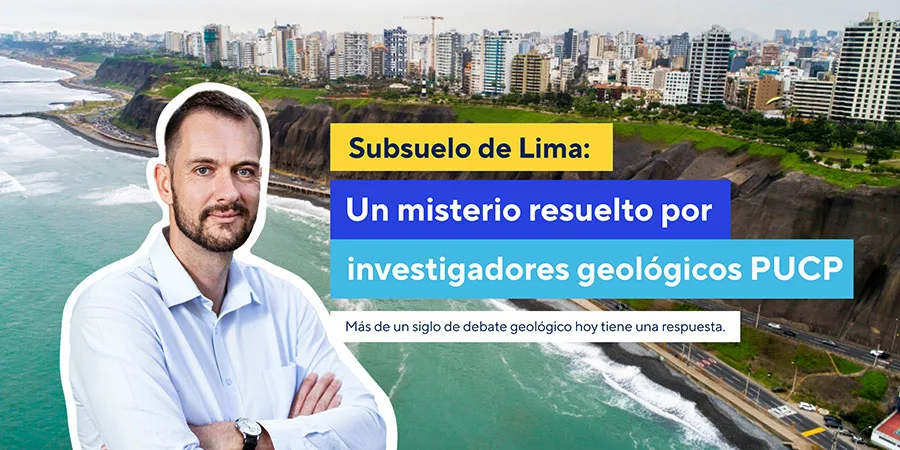
More than a century of geological debate now has an answer.
Knowing about the geological conditions of the natural environment in which the world's major cities are located not only allows us to understand their natural history, but also to understand their territorial planning, their natural risk mitigation and their development of urban tourism. In fact, most countries carry out rigorous scientific research on the geological environment of their capital cities. In the Peruvian case, the most recent geological history of the city of Lima during the Quaternary era (interval from 2.58 million years ago to the present) has been a mystery, especially because science has not been able to answer precisely how and when the subsoil of Lima was formed.
The geological subsoil of Lima has been a subject of debate for more than a century, both for its age and its formation. In 1907 the first scientific work on the geological subsoil of Lima was published, since then there have been several attempts by national and international institutions, as well as by universities in South Africa (2000), Spain (2019) and Switzerland (2019).
However, the scientific investigations published so far have not been able to obtain convincing results, some of them being contradictory, mainly due to inaccuracies in the application of methods used in the study of the subsoil of Lima and also due to a lack of deep knowledge of Peruvian geology.
Solving the mystery: 10 years of geological research
In this context, researchers from the Sedimentary Geology research group of the Pontificia Sedimentary Geology of the Pontificia Universidad Católica del Perú, have managed to solve the mystery.have managed to solve the mystery. The results of their studies have been published in the prestigious international scientific journal Earth Surface Processes and Landformson June 30, 2024.
Dr. Willem Viveen, professor of Geological Engineering and leader of this research, comments that this study demonstrates that the sediments of the Costa Verde have been deposited during the end of the penultimate interglacial and during the last glacial until the beginning of the Holocene. That is, from one hundred and twenty-one thousand years ago until about six thousand years ago, by the action of an ancestral Rimac River. The episodes of increased river flow and consequent sediment deposition could have been closely linked to episodes of intense rainfall during that period.
Contrary to what many scientists thought to date, these rainy seasons were not related to changes in the temperature of the Pacific Ocean, but to changes in the temperature of the Atlantic Ocean, far away from Peruvian territory. Due to cooling at the North Pole, the ice sheets grew so much that they broke under their own weight and ended up in the Atlantic Ocean, where they melted and lowered the temperature of the Atlantic Ocean. Through a complex system of atmospheric processes that crossed the entire Atlantic Ocean, the climate changed on the Peruvian coast, causing intense rainfall during the last Ice Age, forming thick strata of river sediments on the Costa Verde.
Reaching this conclusion was not a short way, researchers from Geological Engineering PUCPresearchers conducted geological studies for more than ten years using the luminescence dating method to date the age of ancestral river sediments in the three natural regions of Peru (Coast, Highlands and Jungle). They found, in each study, that it was during the same rainy periods of the last Ice Age that the sediments of those rivers were deposited. Since the climate in the eastern regions is not subject to changes in the temperature of the Pacific Ocean, they concluded that the Atlantic Ocean should be the driving force behind these climatic changes and the behavior of the ancient rivers.
For our researchers it is a great pride to have solved the mystery of the geology of Lima that many other researchers tried to solve previously. This finding would not have seen the light of day without the persistence and scientific quality of our geological engineers and without the support of the Pontificia Universidad Católica.
Comments