DI+

Research Laboratory for the diagnostic recording and conservation of the heritage

Contacto:

626-2000 annex 4659

The research laboratory was created in 2014 thanks to the support of INNOVATE Peru, the Department of Engineering and the Vice Rectorates of Research and Administration of the Pontificia Universidad Católica del Perú. The laboratory has state-of-the-art equipment for structural diagnosis and monitoring of existing and heritage buildings. It develops innovation specifically in the areas of non-destructive testing and instrumentation of buildings, seismic instrumentation, vibration control, geophysics, 3D reconstruction, numerical modeling and advanced structural analysis.

Engineering and Heritage is a research laboratory with state-of-the-art equipment and technology. This laboratory and the undergraduate, master's and doctoral research assistants that work there allow it to have capabilities to act in different fields such as:

  • Determination of geotechnical conditions by geophysical testing.
  • Mechanical characterization of materials.
  • Geometric reconstruction with drones and laser scanner.
  • Development of educational and scientific tourism experiences with virtual and augmented reality.
  • Structural diagnosis using non-destructive testing.
  • Advanced structural analysis of buildings.
  • Development of reinforcement and structural intervention projects.
  • Seismic and structural monitoring.

View 360° tour >

Equipo humano

Head of laboratory and Director of the research group:
Rafael Aguilar Vélez

Teachers:

  • Benjamín Castañeda
  • Luis Jaime Castillo
  • Guillermo Zavala
  • Carolina Briceño
  • Ruben Boroschek
  • Renato Perucchio
  • Miguel Pando
  • José Luis Ferreira da Silva
  • Susana Moreira

Equipamiento y software

Unmanned flight system for geometric surveying and 3D reconstruction

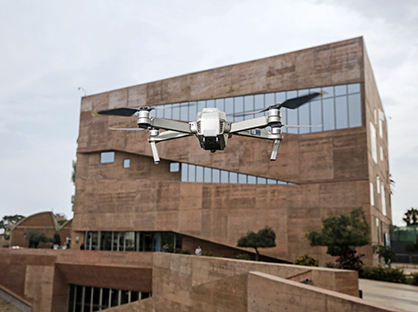
We have a fleet of unmanned aerial vehicles (quadcopters and octocopters), equipped with high-resolution digital cameras and specialized software, which will capture images and videos that will later be used for the geometric and topographic survey, as well as for the corresponding 3D reconstruction.

Optical system for 3D surveying and modeling

We have a state-of-the-art laser scanner that is used for the detailed and automated geometric survey of buildings. The data acquired with the scanner is processed by software, which allows to join the collected data, create animations and design 3D digital models. In addition, post-processing software allows direct manipulation of the scanner data and the generation of solid models.

Equipment for geophysical monitoring

We also have geophysical auscultation equipment, such as a georadar with a full range of antennas, ranging from 100Mhz to 2Ghz, which can be used to explore surfaces ranging from 30m to 30cm deep. With this equipment it is possible to generate three-dimensional models of the analyzed area, which allows, with proper interpretation, to identify objects buried or embedded in structural elements. In addition, the laboratory has capacity for the development of geophysical tests (MASW, seismic refraction and micro trepidations) and for geotechnical exploration.

Vibration and deformation measurement and monitoring system

A series of data acquisition systems and highly sensitive acceleration transducers are available for in situ dynamic testing of existing buildings. These systems provide the capacity to study all types of phenomena related to vibrations and seismic instrumentation, as well as the possibility of integrating and developing permanent monitoring solutions.

Various equipment for diagnostics with non-destructive techniques

The laboratory also has a series of equipment for non-destructive testing and diagnosis of heritage buildings. For example, it has systems for measuring the internal condition of wooden elements, a thermography diagnostic system and an ultrasound system for characterizing materials.

Advanced analytical tools for predictive structural analysis

Finally, we have the capacity to develop structural models with advanced analytical tools that study the behavior of large deformations and even collapse states, which is of special interest when studying heritage buildings. In this way, predictive models can be developed to estimate the behavior of this type of constructions; this, integrated to the information gathered in the field with the techniques shown above, allows their appropriate diagnosis and the development of optimized intervention proposals.

Investigación

  • Heritage Assessment (2019 - 2021) - Development of reverse engineering tools for the structural diagnosis of historic buildings located in seismic areas: The case of the Church of the Company of Jesus in the Plaza de Armas of Cusco.
  • BTC Assembly (2019 - 2021): Implementation of guidelines for the construction of buildings with compressed earth assemblable blocks that serve as an economical and safe construction solution for housing located in regions of high seismicity.
  • Virtual Heritage (2018 - 2020): Interactive virtual and augmented reality tool for the scientific, educational and touristic dissemination of the built heritage that makes up the Andean Baroque route in Cusco.
  • Geoblock (2018 - 2021): Development of ultra-lightweight building blocks with geopolymers.
  • Development of STIC tools for structural diagnosis of emblematic buildings (2017-2018).
  • Profile of the restoration project of the temple of La Virgen de la Asunción in the framework of the project of the cooperation agreement of the District and Community of Sacsamarca (2016-2017).
  • Structural monitoring of emblematic adobe buildings (2016-2017): Integration of knowledge and technology for a proper structural diagnosis.
  • Structural monitoring of adobe churches (2017-2017): Preliminary study in the church of San Pedro Apóstol de Andahuaylillas and San Juan Bautista de Huaro in Cusco, Peru.
  • Preservation of clay mud churches in the Andean region (2015-2016): 3D modeling and nondestructive analysis for seismic response evaluation of the San Pedro Apóstol church in Andahuaylillas.
  • Towards the conservation of monumental earthen constructions in seismic zones (2014 - 2017): Study of geotechnical, seismic and structural behavior conditions in La Huaca de la Luna.
  • Preserving our culture (2014): Complementary equipment for Interdisciplinary Laboratory for Research in the Registration, Diagnosis and Conservation of Architectural and Archaeological Heritage.
  • Pilot Project for the Evaluation of the Current Structural Condition and Seismic Behavior of the Moche Archaeological Complex Huaca de la Luna, massive construction of 1000 B.C. (2013 - 2014).
  • Study of the improvement of the mechanical, chemical and biological properties of adobe using biopolymers extracted from local sources (2013 - 2014).
  • Development and Implementation of New Technologies for the Experimental Diagnosis and Evaluation of Historic Monuments (2012).

Servicios

expand_more
Servicios

The Engineering & Heritage research group was created with the objective of developing innovative technologies for the conservation and monitoring of heritage buildings, with the multidisciplinary collaboration of professors and undergraduate and graduate students of Civil Engineering, Electronic Engineering and Archaeology. The future vision of Engineering & Heritage is to generate knowledge to conserve our heritage and to bequeath it to future generations.

Capabilities

  • Geophysical testing to determine geotechnical conditions
  • 3D reconstruction with drones and laser scanners
  • Digital topography
  • Structural diagnosis by non-constructive tests
  • Advanced structural analysis
  • Seismic and structural monitoring
  • Vibration control

Sources of financing

  • Innovate: Fund for scientific equipment for laboratories
  • Concytec: Scholarship Fund for the Master's Degree in Civil Engineering
    PUCP: DGI Research Projects Fund.
Share Via: