
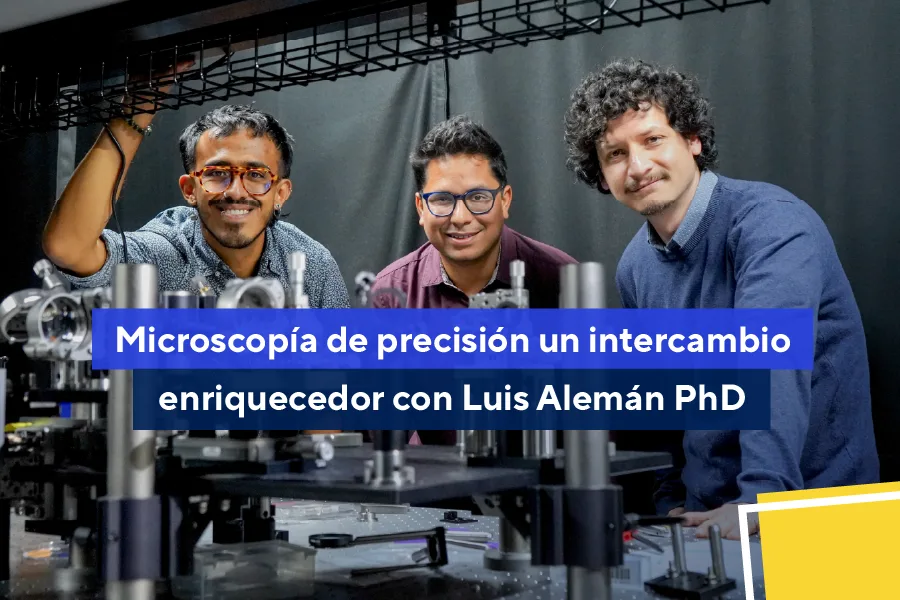
A few months ago we received Dr. Luis Alemán, visiting professor and expert in advanced microscopy. He is a professor and researcher at the Fresnel Institute in Marseille, France, one of the most important research centers in optics and photonics in Europe. His stay has significantly strengthened research in biophotonics and has promoted new lines of collaboration with our academic teams and research groups.
During his time on campus, Dr. Alemán not only shared his knowledge, but also actively worked on high-impact projects and participated in teaching, enriching the experience of both students and researchers.


A journey into the world of fluorescence microscopy fluorescence microscopy
His interest in fluorescence orientation microscopy grew out of his fascination with the polarization of light. "Polarization is an inherent property of light and by knowing how to manipulate it one can obtain extra information about matter," he explains. This ability to infer the orientation of molecules and proteins in cells and tissues has been the focus of his work, particularly in super-resolution techniques that reach nanometer-scale accuracies, essential for cellular studies.
Key Project: Two-photon microscopy of the human cornea
During his stay, he collaborated closely with professors Dr. Fernando Zvietcovich and Dr. Omar Ortiz in the construction of a two-photon microscope. This state-of-the-art equipment is designed to obtain volumetric (3D), high-resolution, high-contrast images of the collagen fibers of the human cornea, all without the need for external markers.
"Our goal is to exploit the polarization of light to simultaneously estimate the location and orientation of these fibers," states Alemán. A direct and highly relevant application of this technique is the study of the evolution and treatment of keratoconus disease, including the search for early detection indicators.


Benefits to society: Beyond the limits of traditional microscopy
Two-photon microscopy offers crucial advantages over traditional techniques, especially for bulky samples such as tissues. It allows greater light penetration and eliminates background noise intrinsically, thus improving contrast. Collagen, an abundant protein in the body, is naturally suited for this technique.
In the context of the Biophotonics and Biomedical Optics Group at PUCP, which studies the human cornea, this tool represents an invaluable opportunity to complement existing studies and advance in the diagnosis and treatment of eye diseases.
Fruitful collaborations and an enriching teaching experience
Dr. Alemán - Castañeda worked mainly with the Biophotonics and Biomedical Optics Group, actively participating in meetings and contributing his expertise in microscopy and polarization to the various projects of the group. In addition, together with Professor Omar Ortiz of the PUCP Physics Section, he initiated an exploratory collaboration on the use of structured beams in optical tomography (OCT).
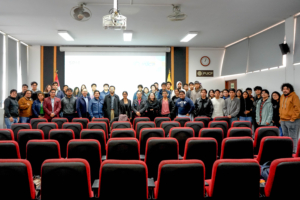
His experience as a guest lecturer in the Medical Physics course was also very positive. "I am surprised at how well organized, the excellent state of the classrooms and the support material," he commented, highlighting especially the level of preparation and interest of the students.


The richness of synergy and the legacy of a productive stay
"The greatest richness of working with such a group and with Dr. Zvietcovich is the dynamism they have," referring to the diversity of projects in imaging and OCT elastography. "There was good synergy and complementarity between the group's knowledge and mine."
He takes away from his stay in Peru and at PUCP not only a deep learning about the OCT technique, but also a renewed energy for his research and the desire to continue and further develop his collaboration. "I can only be grateful to PUCP and Peru for having received me so well," he concluded.
This collaboration is a clear example of PUCP Engineering's commitment to cutting-edge research and international links, promoting the development of technologies with a direct impact on health and well-being.
Comments